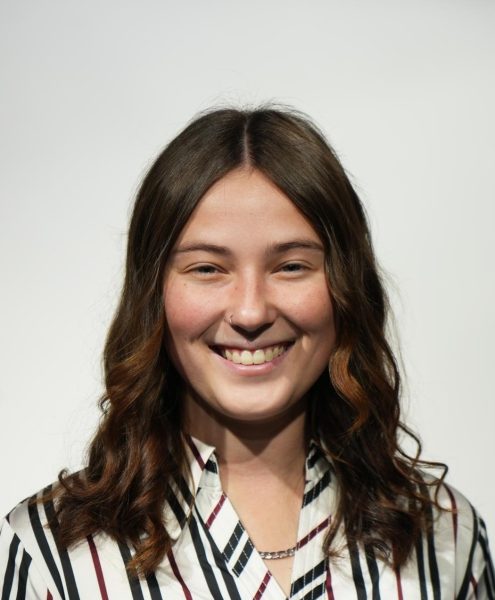


For Kim Carlson, research and the funding struggles it brings is nothing new.
Due to federal budget cuts earlier this year and grants being terminated, there is uncertainty surrounding the University system’s research grant funding, which may receive budget cuts.
“I think no matter where you’re at, what research you’re in, funding is always the hardest part,” said Carlson, a UNK biology professor and assistant vice chancellor for research and creativity.
Carlson is not the only one thinking about how these cuts could affect UNK.
“Many of our on-site graduate students do have graduate support funding, research funding in some fashion, so probably there would be a somewhat greater impact at the graduate level, lesser at the undergraduate,” said Charles Bicak, UNK’s interim chancellor.
Though a lot of funding comes from the National Institutes of Health and National Science Foundation, Carlson said that there is also private funding through foundations that UNK’s researchers can take advantage of, which most people forget.
“The truth is the funding environment is always changing,” Carlson said. “It’s always in flux, and it depends upon who’s our president as to what the federal funding profile is.”
Carlson has been looking into these sources, due to uncertainties with federal funding and because one of her current grants concludes at the end of April. Although, she has received “Just-in-time” documentation, which means there is a lag and that the original cutoff date has been missed. Though this does not mean it will be renewed, Carlson said that it is a good sign.
Securing funding is not Carlson’s only job. Since coming to UNK in 2003, she has taken on more roles. She is a full-time faculty member, the senior research officer, the federal relations officer and still continues research on fruit flies with her students.
“My lab is known throughout the world because we work on this (Nora) virus,” Carlson said. “People need fruit flies to infect with this virus.”
Carlson’s lab was the first to discover the Nora virus in the US. They now focus on studying the virus infecting the flies. They also send other researchers flies if they request them.
Carlson has run the IDeA Network of Biomedical Research Excellence program, a federal grant-supported program to train undergraduates in research, since her arrival.
With the hard part of obtaining grants out of the way, Carlson said she loves working with her students in the lab.
“They have to have fun when they do research,” Carlson said. “I’ll come up sometimes on a Sunday and they’ve got music going, and they are just having a great time, and I love to be a part of it.”
Sunayn Cheku, a senior molecular biology major, said that she is very passionate about her research and students.
“She’s a very open person, and she makes it very clear that if you need help with anything, you can go and talk to her,” Cheku said. “Her office door is always open. She never closes it.”
To increase the students’ abilities to contact her, Carlson bought Echo Dots for her lab, offices and home to make it easier for her students to contact her while they work. The Echo Dots can be used like an intercom system because of their Alexa Drop In feature.
Carlson said one day she could hear voices in her kitchen because her students used the drop-in feature to talk to her from the Echo Dot in the lab.
“I’m here to help them (and) it should be fun,” Carlson said. “And if it’s not fun, you shouldn’t do it. So we have a lot of fun in the lab. I love that.”
Carlson creates that fun lab environment by nurturing the connections she has with her students.
“She pulled us (students) both aside and said that she was having a mom moment,” said Belle Turk, a senior majoring in psychology and minoring in biology. “Then she proceeded to lecture us for about five minutes on why we shouldn’t wear shorts in the middle of winter. I just think about that all the time because it makes me laugh that she called it a mom moment, and also just that she cares enough to treat us like her own children.”
Though bittersweet, Carlson said she is always extremely proud of her students and their accomplishments when they graduate. She still stays in touch with her prior students and is always up to date on what they have been working on and where they are in the world.
“They’re my family forever,” Carlson said.
UNK, including Carlson’s lab and students’ research, is getting recognized by the American Council on Education and the Carnegie Foundation. Despite funding concerns, Carlson said every new administration changes how funding is done, and just like the ones before, this one will get sorted out, too.
“At the same time that we are concerned about the impact, we don’t wring our hands,” Bicak said. “We move ahead and make the best of it, because in the end, like I say, our obligation is to you all, to students, and the best working conditions, best experiential conditions to set you up for success when you leave here.”