

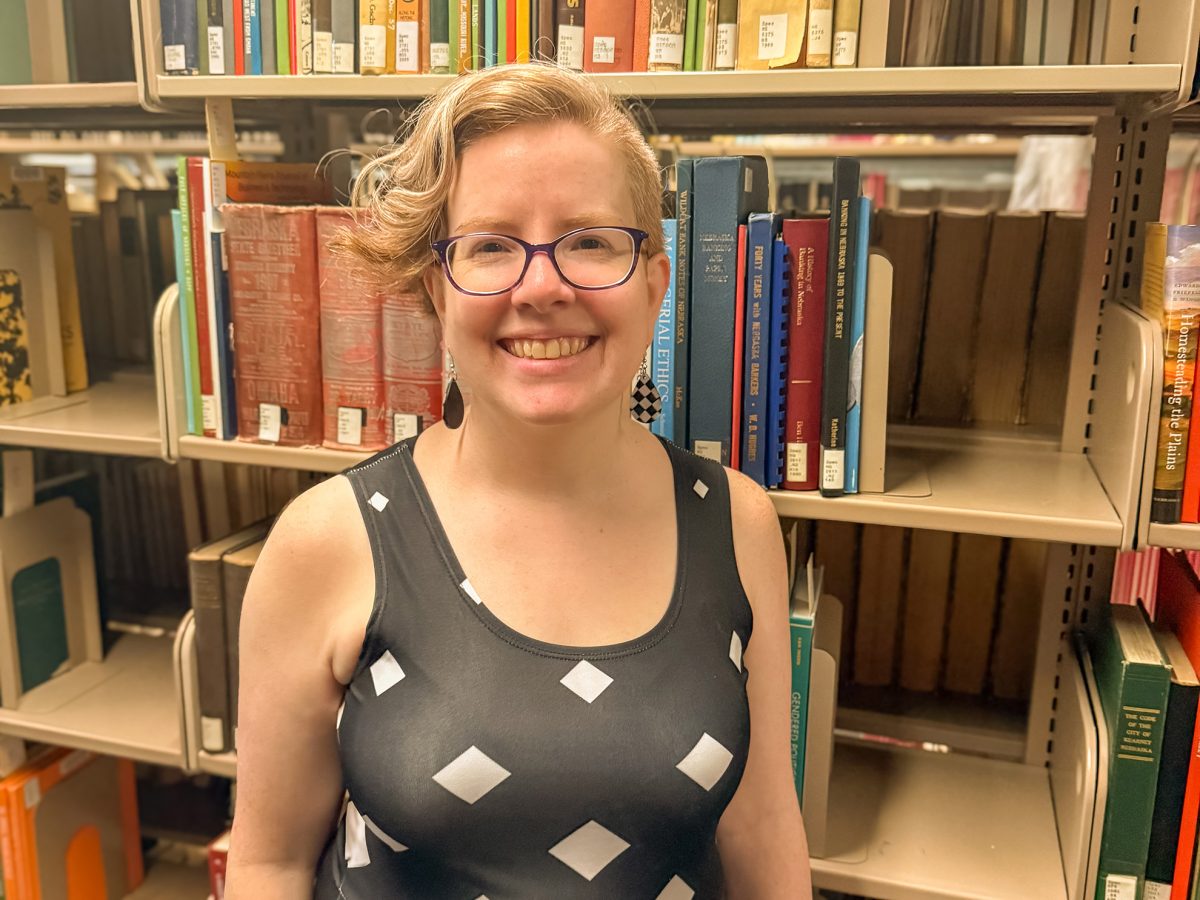
Restoring and preserving local history might be a challenging task, but it’s one Laurinda Weisse tackles every day. As the UNK archivist and digital repository manager, she provides the community with important historical information.
Archival skills allow Weisse to assist the broader community.
“I know a lot of people go into libraries or archives because they love books, (and) that’s fine,” Weisse said. “I went into it knowing that I wanted to help people. With my background and interests, archives was the way I could do that.”
Weisse, originally from southeastern Wisconsin, moved to Nebraska after getting a temporary position at UNK as a reference and special projects librarian.
Then, a new opportunity arose.
“They let me know at the time that they might be opening an archivist job,” Weisse said. “I applied for and got that, and I’m actually the first trained archivist that the University has ever had.”
Before Weisse’s time at UNK, she attended the University of Wisconsin where she received a Bachelor of Arts in history, anthropology and Latin American and Caribbean studies.
Afterward, she attended the University of Michigan and received a Master of Science and Information with a specialization in archives and records management and preservation of information.
Since October of 2014, Weisse has organized collections, reached out to donors, taught, put together exhibits and managed UNK’s digital repository.
Weisse’s work stretches outside the reach of UNK and into central and western Nebraska.
“By preserving and making (this information) available, we’re giving people the building blocks to tell their own stories,” Weisse said. “Whether that’s the story of UNK, the story of their family, their individual story or a more academic-focused story. What we’re doing is providing those basics so folks have something to build upon.”
Jenny Haddon, UNK’s processing and outreach archivist, has worked closely with Weisse since August of 2021, and said archival work is a core part of the institution.
“If you want to romanticize it, you can kind of say that the special collections and archives are the heart of the institution,” Haddon said. “What kind of a place would this be if people only remembered the last 20 years? Where can the pride for your institution come from if you don’t go back all the way?”
Weisse said building connections was important when she first started at UNK. That remains true today.
“The big thing with archives as a whole and here at UNK is that they truly are open to everyone,” Weisse said. “My main job is to help connect people with the archives. It’s great to preserve these things, but it doesn’t matter if no one knows it’s here or feels like they can come in and use it.”
Nathan Tye, a professor in UNK’s history department, said Weisse plays a key role in his research.
Weisse assists Tye by “providing the skills, the expertise, (and) the knowledge” needed for his research. He said she is great at providing the materials that make his scholarship possible.
Tye said everyone should use the resources and assistance Weisse provides, and that she is an “incredible steward” of the materials she cares for.
“Laurinda is one of the hardest working people on campus by far, and handles a wide range of tasks (like) assisting students, alumni, community members and faculty day in and day out, and has a collection that is incredible,” Tye said. “More students, faculty and community members should really take advantage of what is available because all of that material is available to use, to research, to engage with, and you’re going to learn so much about the state, the nation, your community and campus with what is there.”
One of the most memorable projects for Weisse was a “Coming to the Plains” Latino oral histories public exhibition, which included banners in the library and a video installation.
“One of our students who was both a volunteer and interviewee for (the project) put it really greatly, and she said something like ‘By being able to tell my story and have other people look at it, it makes me feel like my story is worth something’,” Weisse said. “I also had at least one or two folks who had major reservations about immigration come out of the exhibit and the showing with their minds changed, and (they) expressed that to me.”
When discussing other oral history projects, Weisse said providing representation is what matters.
“We want archives to represent the communities in which we live, and that hasn’t historically been the case,” Weisse said. “So, (you) gotta go and make it happen sometimes.”
Weisse had one thing to clear up regarding the archives department.
“The white gloves are totally a myth,” Weisse said. “We don’t use white gloves in archives.”